stick house
A stick house appears when the snow melts. The kids gather downed branches and balance them in shrubs. They have only recess to build, then the structures left behind by one group become raw material for the next. A fort meticulously assembled by first graders is dismantled by the third graders an hour later, the sticks dragged to a new location, arranged into something else.
Scarcity is the source of many disputes. Over sticks, over space, over who is in and who is out of play.
There are accusations, negotiations, alliances. I watch children working out questions of ownership and commons and justice. Who owns what they build? What happens to it when they leave? Do you owe anything to the person who built before you?
The word belonging cuts both ways. The kids grapple with the predicament of wanting control and also seeking acceptance by the group. Much of this feels like children exploring and quarreling. But a part of me also senses the fingerprints of the broader culture, to which kids are especially attuned. After all, we are in the land of high hedges, a place steeped in the logics of ownership, of property lines, of guarded in-groups and priced-out outsiders.
Plants don't think in terms of meets and bounds, especially bamboo.
in the grove
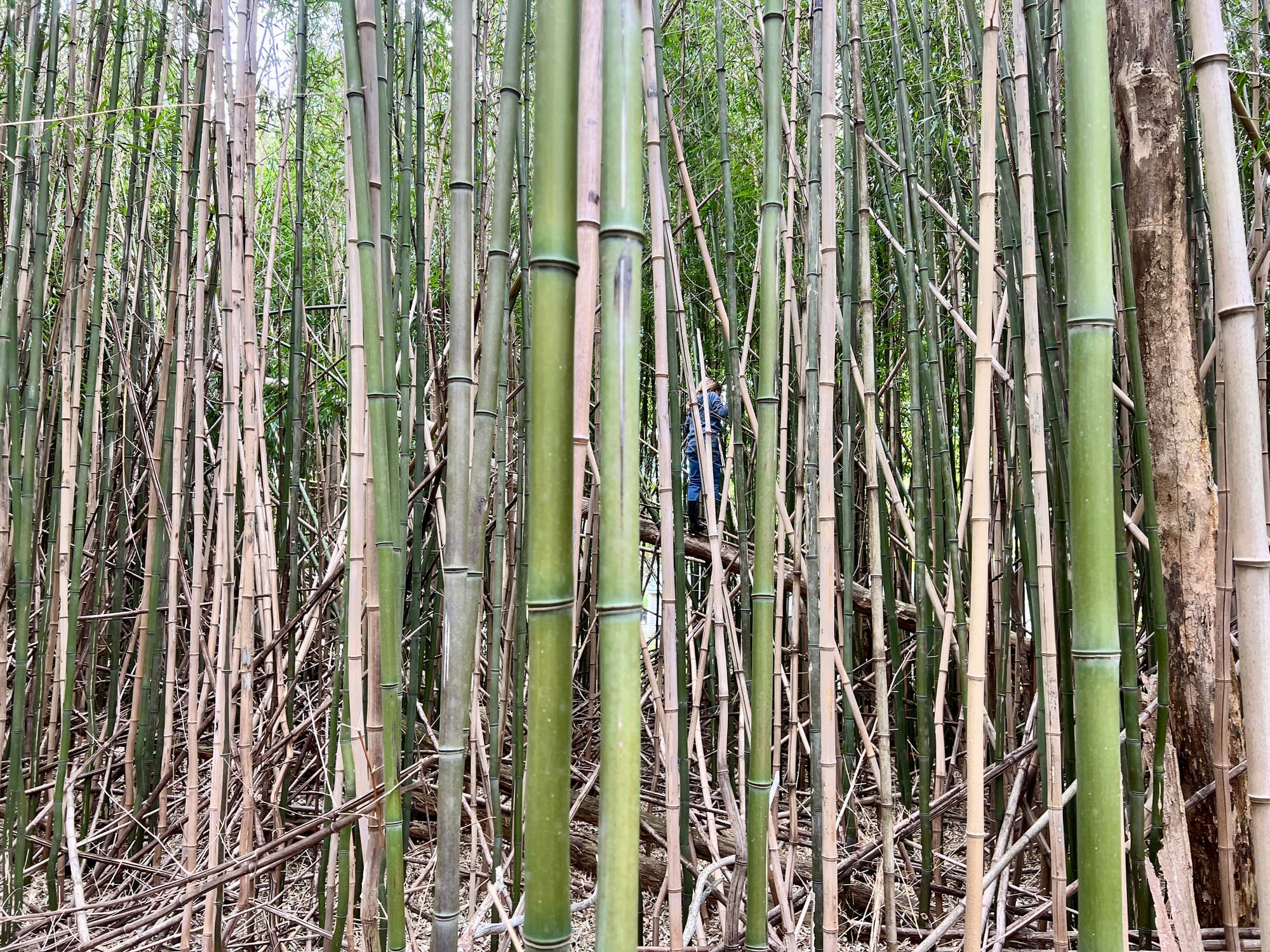
I'd been driving past a grove on my way to school, a thick stand you can't miss, planted years ago for privacy screening, now aggressively sending runners underground, crossing property lines, shading out everything beneath it. Step inside this bamboo grove and the world changes. The canopy closes overhead. The soundscape shrinks, muffled but for the eery chatter of dry canes brushing against one another, or the limpid, almost vitreous sounds birds project through this thicket. The canes grow so dense and tall that even in winter, when everything else is bare, they stay green, and the leaves way up high catch the wind in a way that evokes hissing water. You feel like you're deep in a mountain forest somewhere, and then the LIRR thunders by, shaking the ground, shaking you free of the illusion that you're somewhere apart from hamlet center.
bamboo, a traveller
Bamboo is a grass, belonging to the Poaceae family. There are over 1,400 species of bamboo worldwide, native to every continent except Europe and Antarctica, most abundant in Asia and South America. A cane reaches its full height in a single growing season. The diameter it starts with is the diameter it keeps. It doesn't add rings the way a tree does, its height dependent upon its specific species.
The flowering is stranger. Most bamboo species are monocarpic. They flower once, then die. Not just the individual plant but the entire species. All the plants of a given species, wherever they are, flower simultaneously. A grove in Connecticut. A stand in Kyoto. The cycle depends again on the species. Some flower every fifteen years, some every sixty, some every hundred and twenty. Phyllostachys aurea, Golden Bamboo, is the running species most commonly planted for privacy screening along the East Coast. It has a relatively short cycle. Phyllostachys bambusoides, another running bamboo widely planted for screens and specimens, holds the record. A 130-year flowering cycle. After flowering, the entire stand dies. Then new plants grow from seed.
No one fully understands how this happens, how the bamboo knows.
Humans have been building with bamboo for at least 5,000 years. Paper made from bamboo fiber was developed in China around 105 AD. Bamboo scaffolding still goes up on modern high-rises in Hong Kong and Guangzhou, lighter than steel and faster to assemble. In the cultures where it grows natively, bamboo does almost everything, from shelter and food to medicine and music. In its modern industrial form it becomes flooring or toilet paper. The plant is so useful that it has been carried everywhere people have gone, planted in climates it didn't evolve for, and is now crossing property lines from Connecticut to California.
I went looking for a place to harvest what I needed for the project taking shape in my imagination. I wanted to see what my students and I could learn from building with this giant grass.
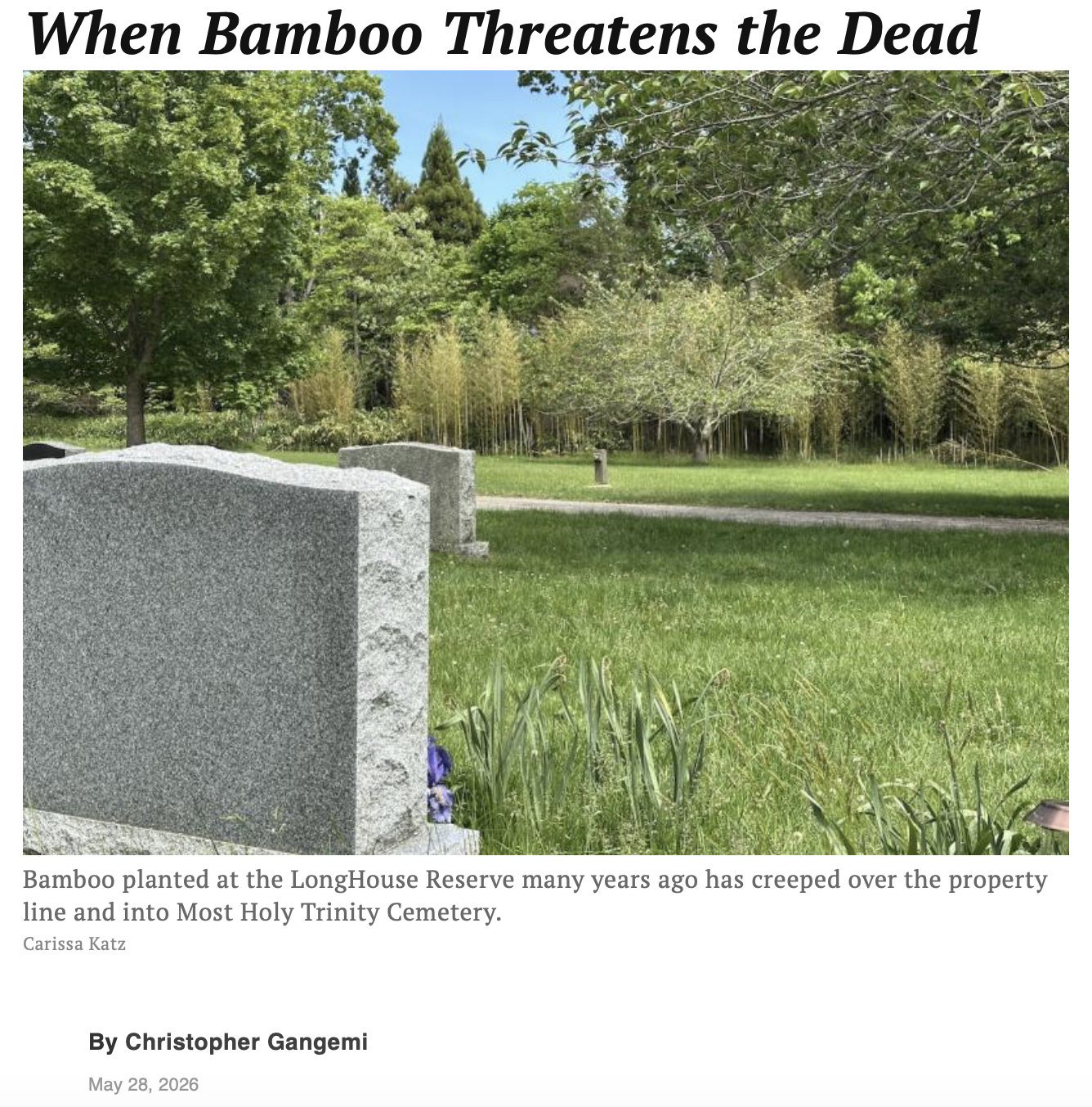
I was in a grove scouting when a parent texted me a link. The East Hampton Star. "When Bamboo Threatens the Dead." Bamboo was planted at the LongHouse Reserve in the 1990s. Jack Larsen loved the aesthetic of Japanese gardens. But in recent years the bamboo had crossed the property line into Most Holy Trinity Cemetery on Cedar Street. It was now growing into burial plots. The church was petitioning the town planning board to modify a special permit so they could enter a non-disturbance buffer and stop it. There was talk of exhumation.
the longhouse
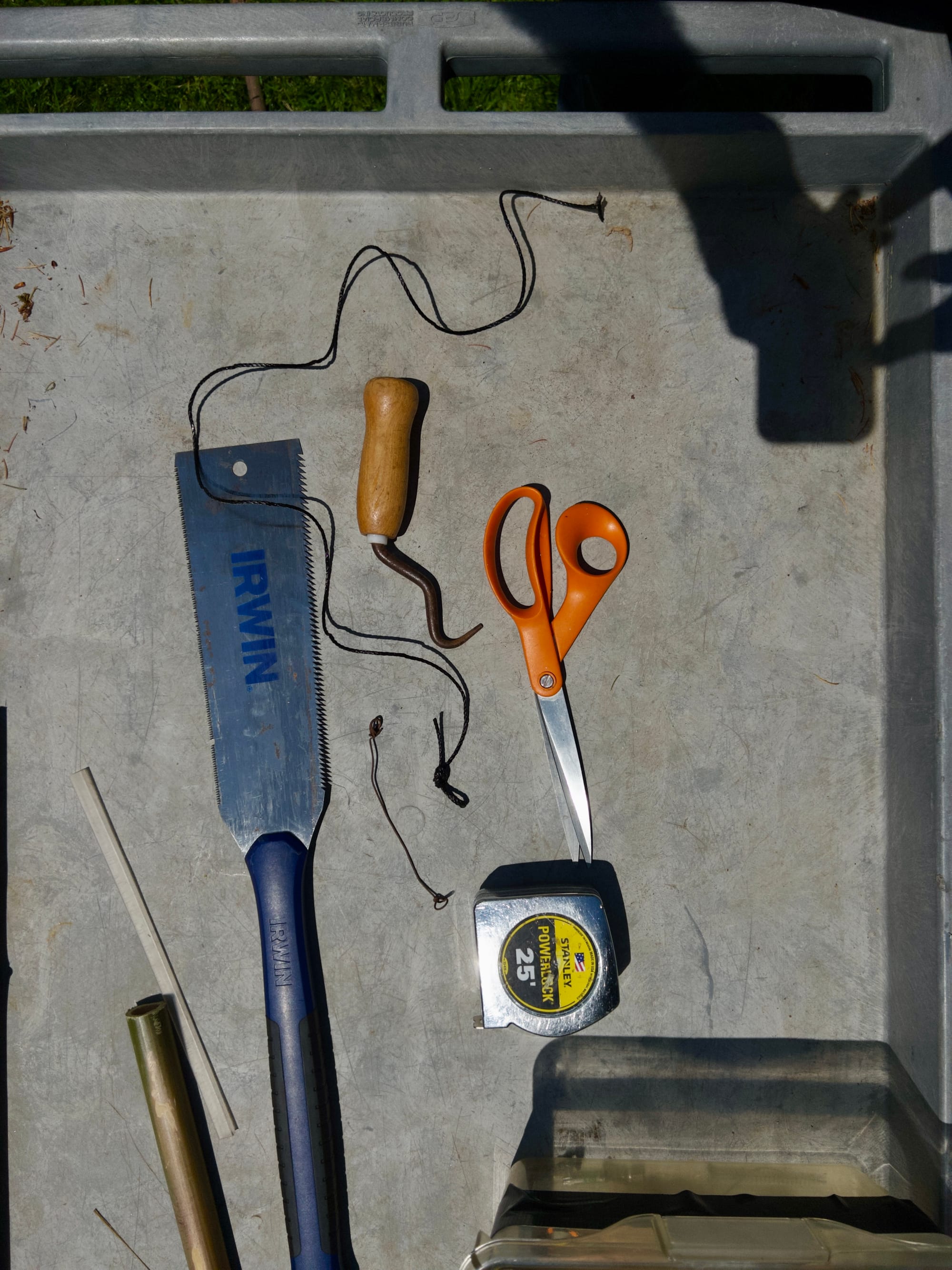
I made a rack on the roof of my car and drove to the grove each morning before school, working my way through with the hand saw and a hedge layer's axe to strip the branches. I'd lash the canes together, load them on the roof, and drive to campus. The students helped drag the bamboo down to where we were going to build. I brought in material, some twine, and marked off the space for construction.
Working with green bamboo teaches you something fast. It's flexible and forgiving, but as it dries it contracts, grows rigid and brittle, and the lashings you tied tight will loosen as the water leaves the vascular tissue. I learned this early and adjusted. I used green bamboo for the structural pieces and allowed them to dry in place. I also cut canes that had dried standing. They were much lighter and already contracted. I discovered that splitting a cane along its length with a machete doubled the surface area of each piece, which meant double the coverage on the structure at half the weight.
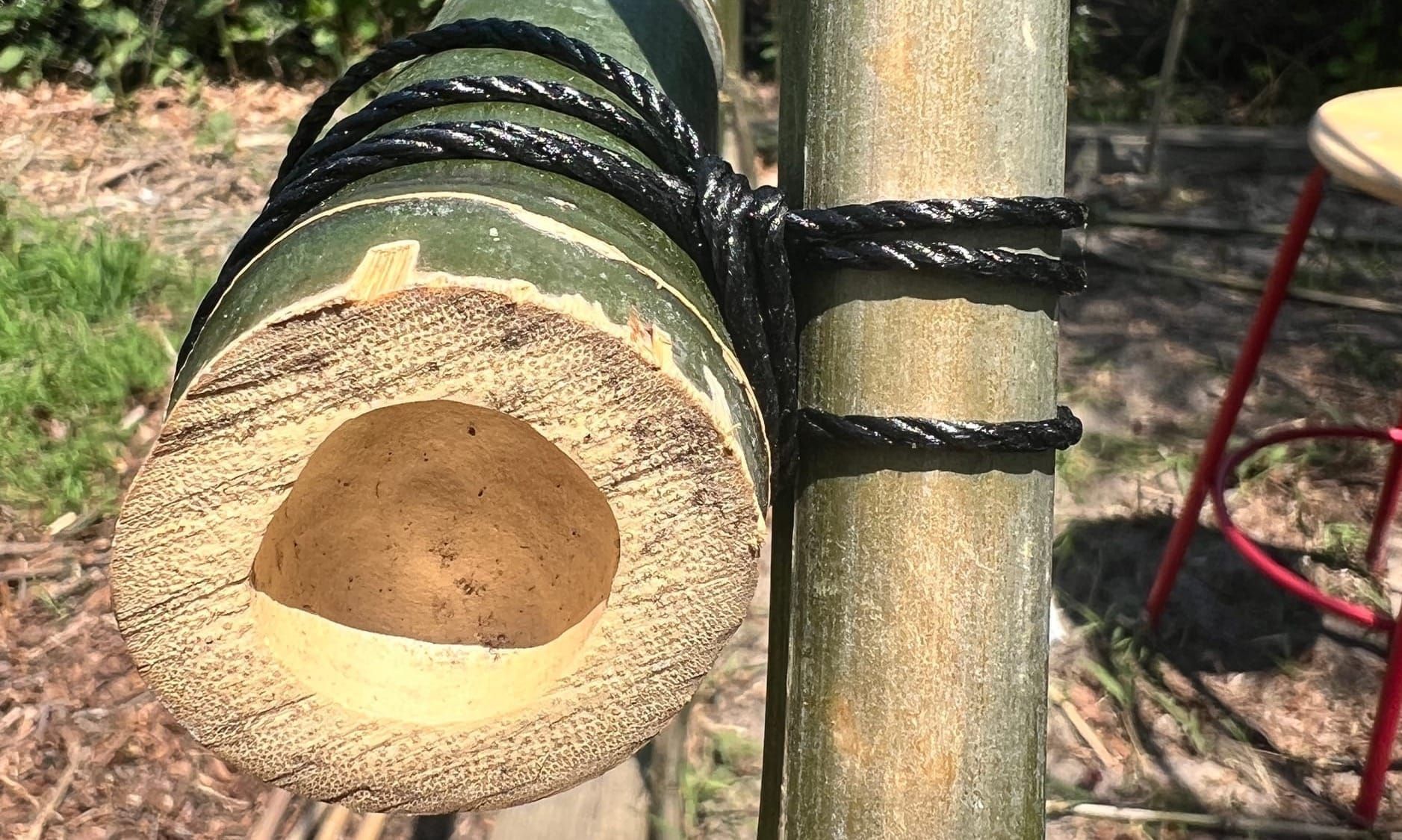
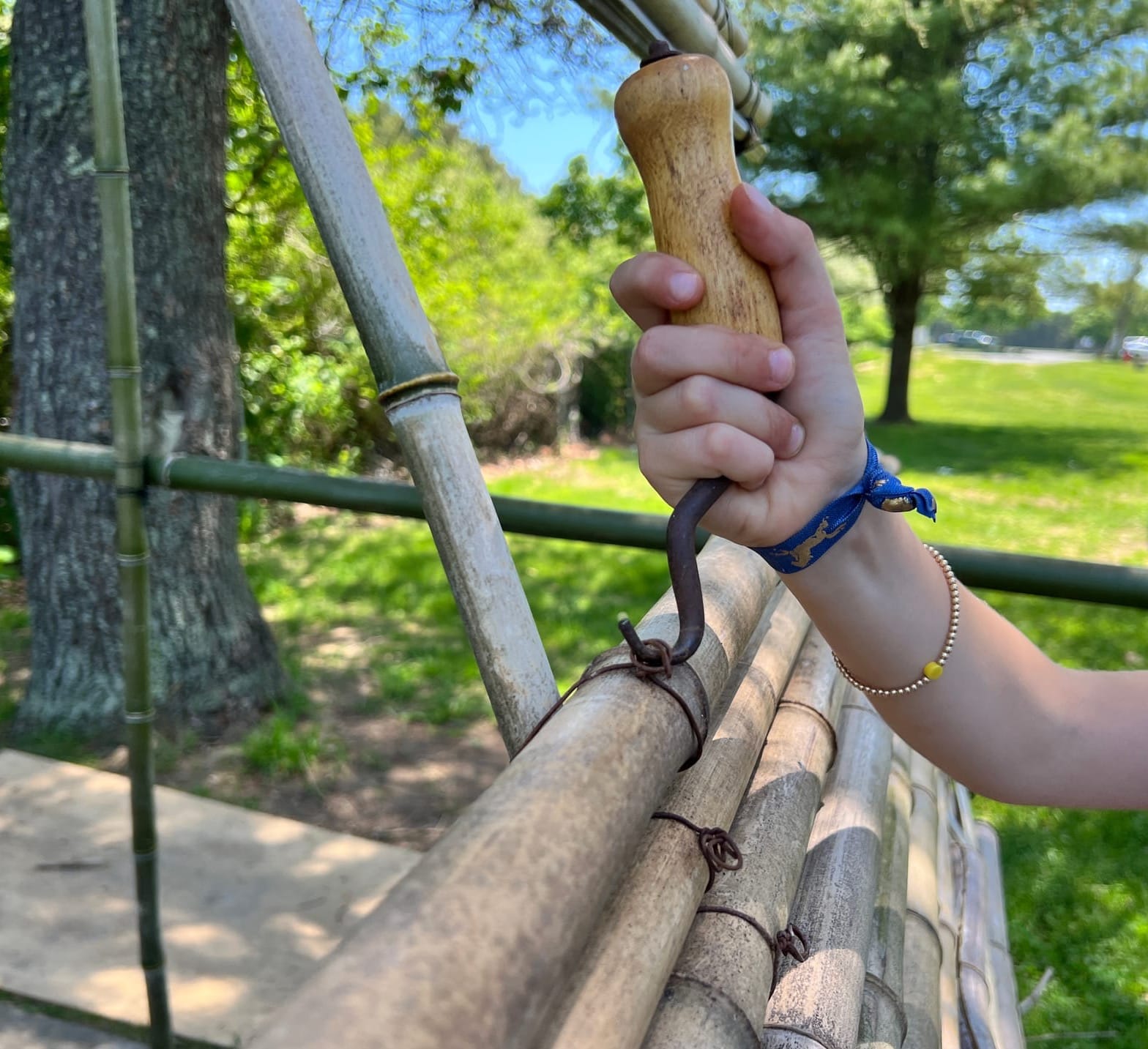
The third breakthrough was a tool. A potato bag wire twister with a double-loop wire tie, the kind used to tie potato bags, turned out to be exactly what we needed to lash bamboo fast and tight. Kids from second grade through fifth could use it with minimal instruction.
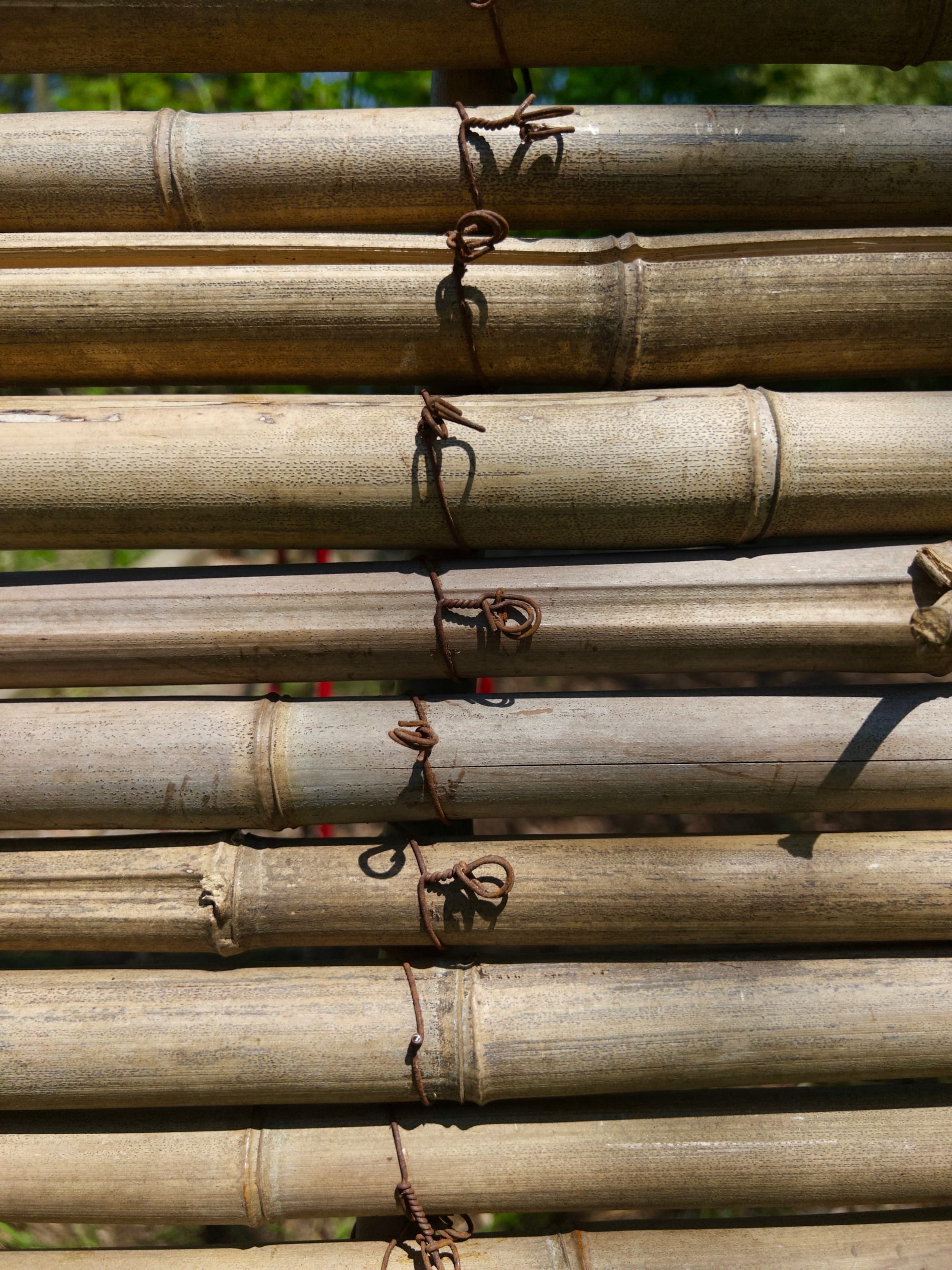
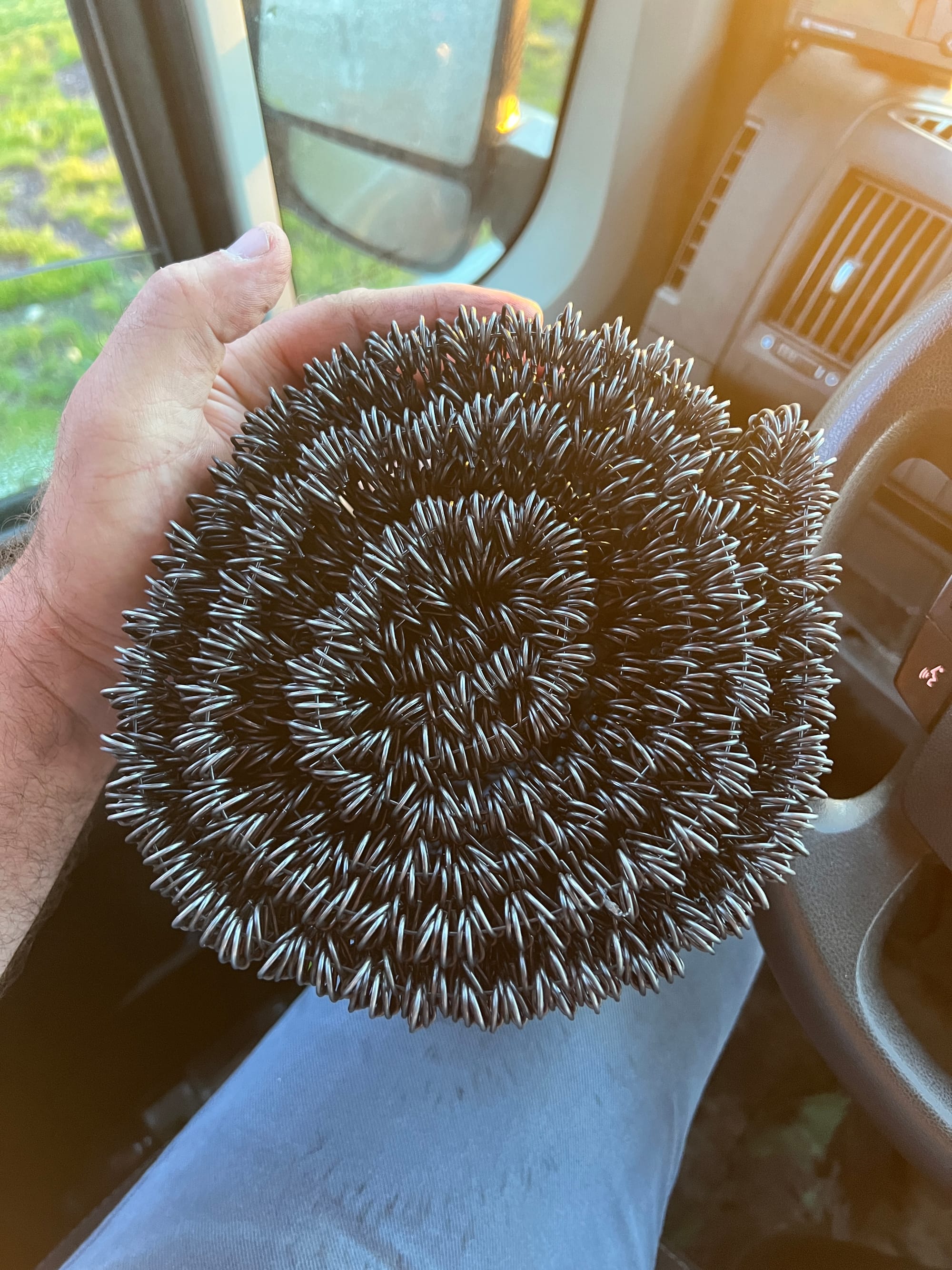
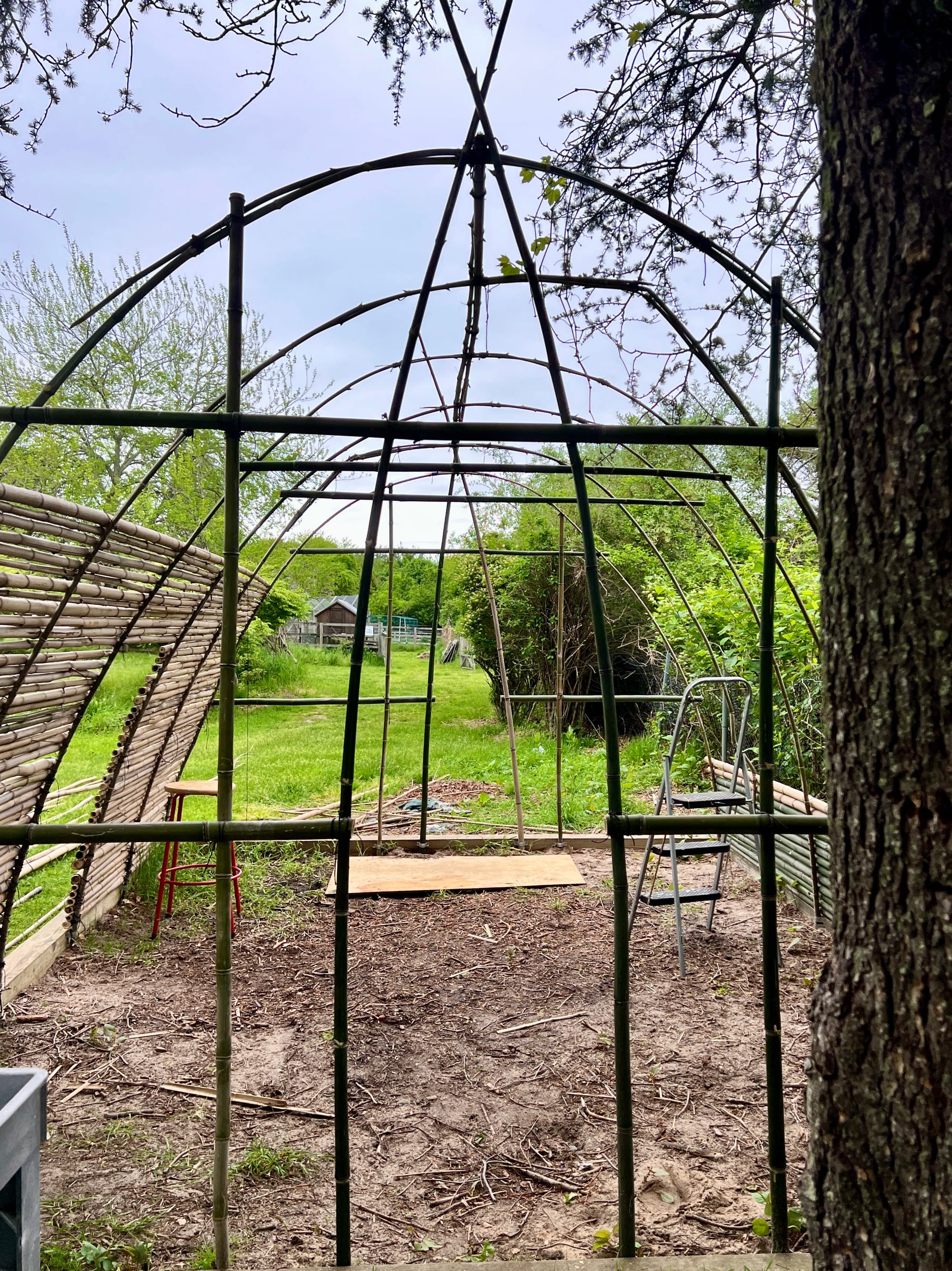
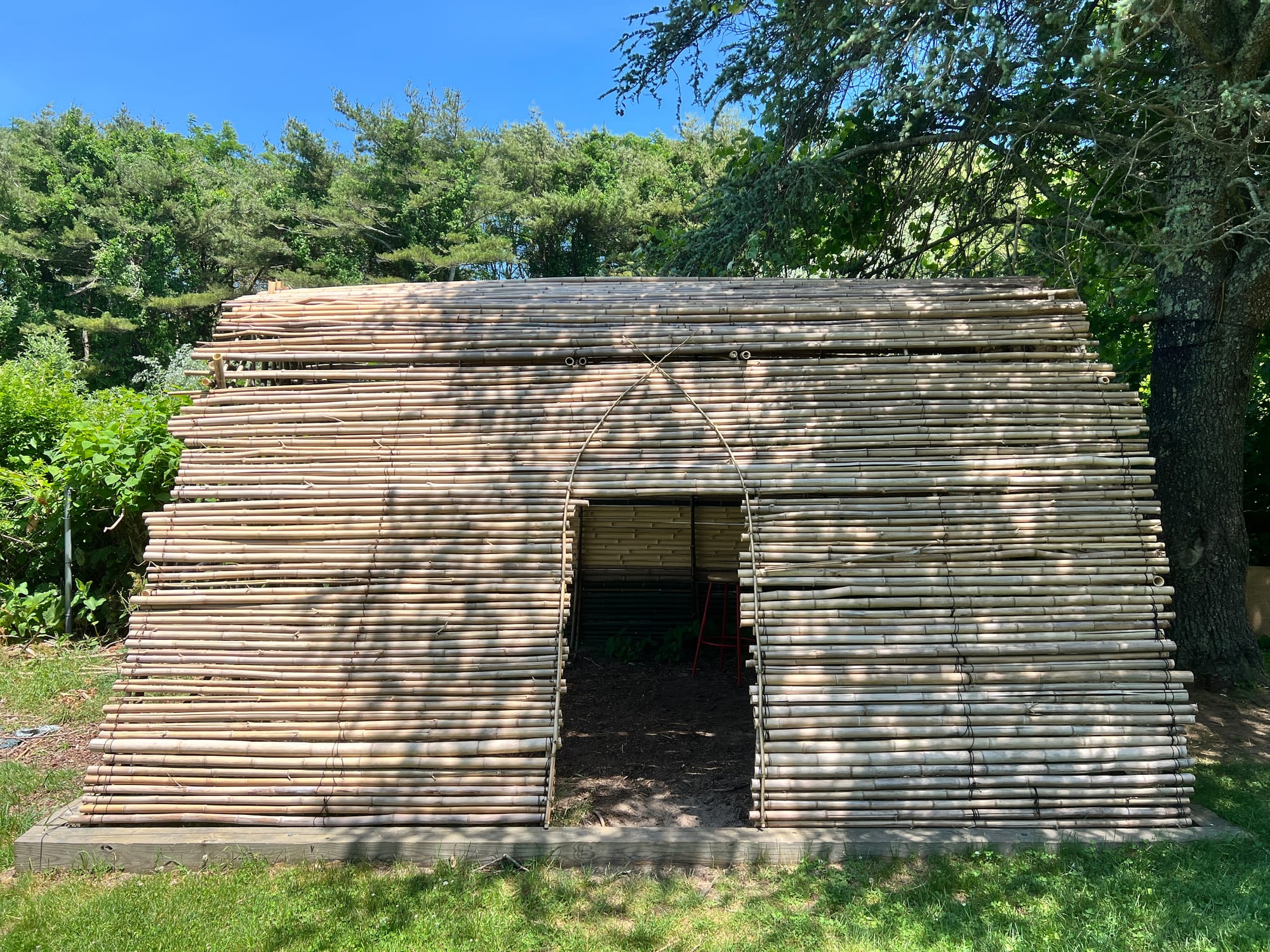
I had a shape in mind. A longhouse. Four hoops, like a greenhouse, with horizontal lengths lashed perpendicular up and over. The form came from something I'd seen in books, but once we started building the structure, it began shaping our interactions. Kids would come at recess, work for a while, drift off to play something else, circle back another day. It was easy to join and easy to leave. Nobody had to commit to the whole project to be part of it.
We had three wire twisters and two ladders. As the walls grew taller, the lashings needed to go higher, and the ladder became the scarcest resource on site. Kids who had put in time and mastered the wire tie asserted themselves. It wasn't out of selfishness exactly, but a felt sense of quality. The lashings had to be tight enough not to slip. They knew how to do it. That knowledge conveyed authority.
At times the building felt less like construction and more like weaving a gigantic upside-down basket. The form and growing weight of it changed how we approached design. The more skillfully we wove bamboo in response to that weight, the stronger the structure became.
Nobody could agree on what to call it. The kids called their own improvised constructions stick houses. This was something else. People said the hut, the bamboo hut, the longhouse. Someone joked it was move-in ready at six thousand a month.
Schools are tightly regulated spaces. They are designed to look a certain way, serve a certain clientele, be maintainable by a grounds crew that can move through the whole property in a single afternoon with mowers, string trimmers and leaf blowers. We built the longhouse in a niche, out of the way, not prominent. A lot of people walked past it without noticing. It had to be pointed out.
Everyone, eventually, asked the same question. What's it for?
Parents asked. Colleagues asked. Administrators. Kids. At first I gave the curricular answer. Third grade has an integrated unit on early human history. A longhouse is a traditional form, used by people for millennia. We could pair the research with something students could actually stand inside, feel the scale of, inhabit. That satisfied some people. Others gestured toward Dewey and Gardner, multiple modalities, hands-on learning. Those connections are real, but they always felt forced, perfunctory.
What I kept coming back to wasn't a rationale. It was a feeling.
Looking back, I was pursuing the joy of making something by hand, from start to nearly finished, the rhythm of the tasks its own reward. Scouting, cutting, carting, splitting, lashing. Each phase making its unique claims on attention. And what the rhythm brought, once I was in it, was connection. I appreciated the bamboo's weight and resistance, the way wet sawdust piled in the saw kerf as I severed a cane from the earth.
When a cane fell in the grove, it revealed a patch of sky it had been jealously climbing toward, opening space for sunlight on the understory below. The rigidity and straightness of the bamboo were in conversation with the sinuous black twine. The pattern a good lashing made was itself a small adornment. The wire cuts on my hands stung when I soaped up at the end of the day. Getting the tension right before the twist took intelligence, a feel for the moment of resistance just before it locks. Over 1,400 double-loop wire ties, so far.
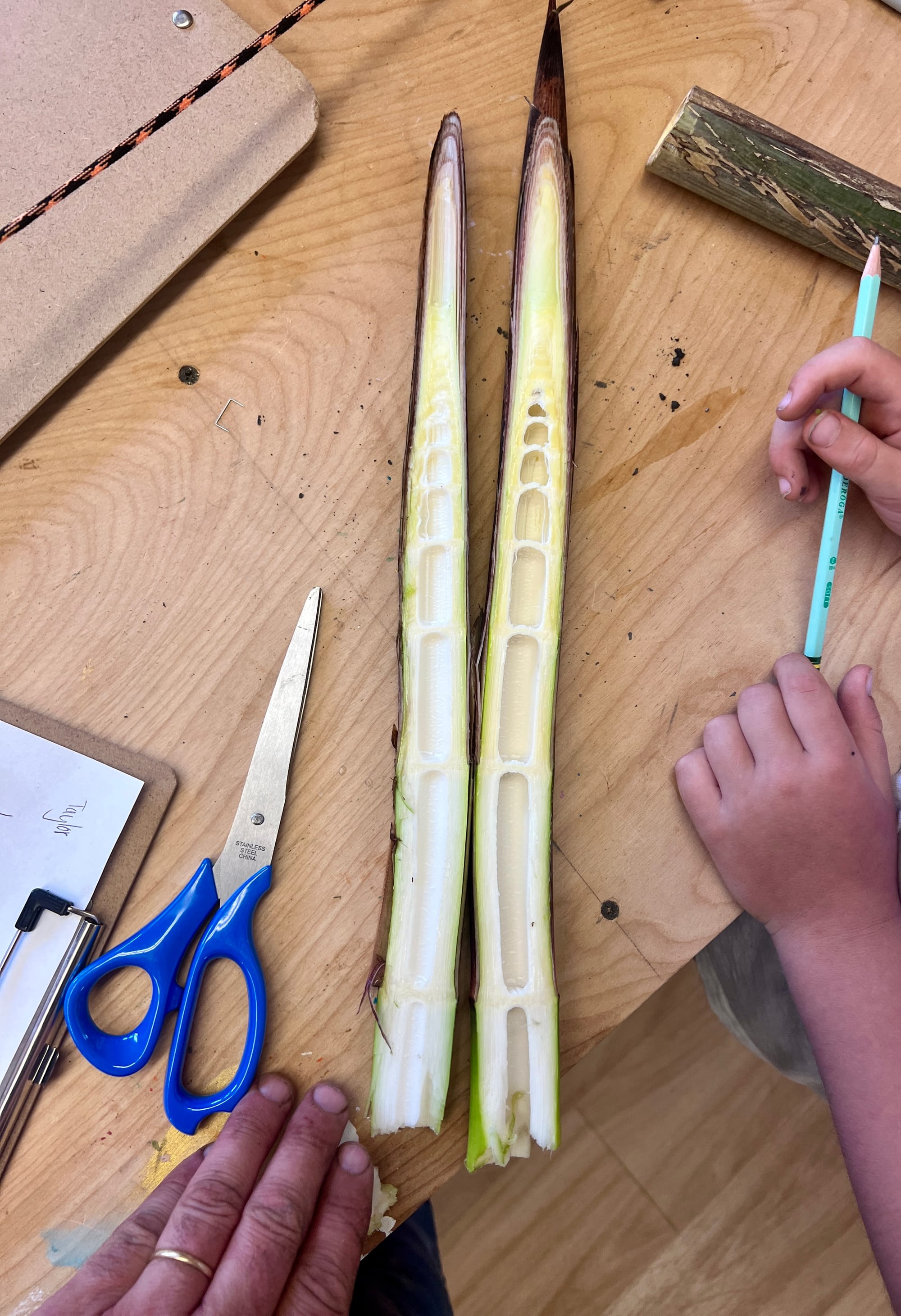
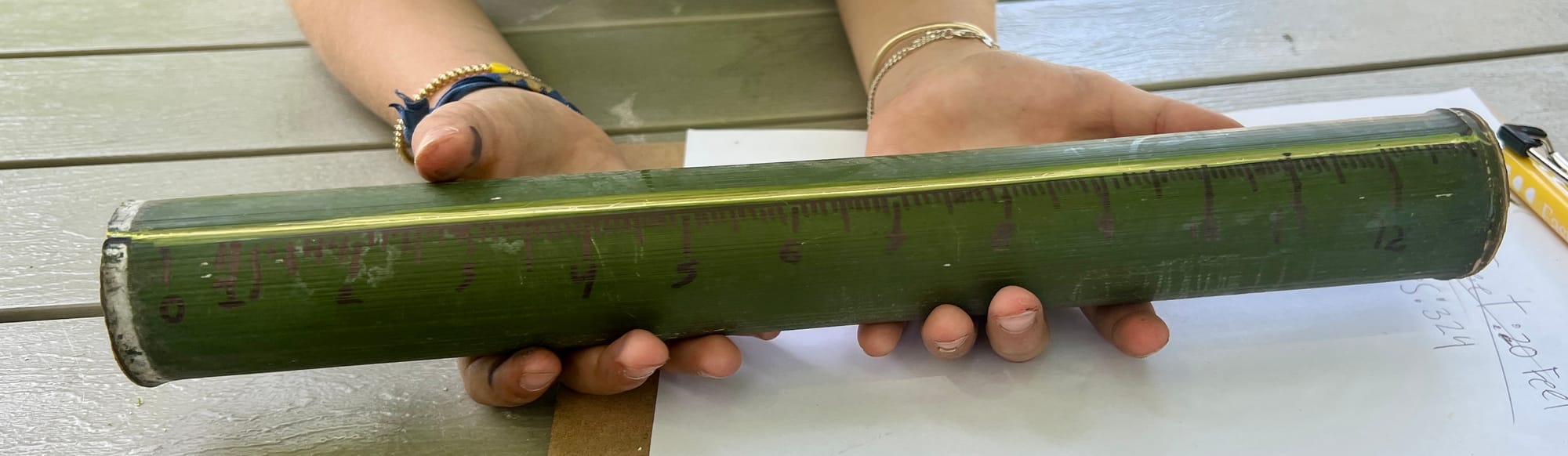
The kids talked while they worked, snippets of their classroom lives drifting through the slats. The joy was also hearing the questions arise. Why is it hollow? What happens if we drill out this part? Does that make a tube? What's this paper inside? Will the roof keep out the rain. Can we build it so it does? Why are the parts between the knuckles all the same length?
For children, observation, play, and imagination braid together. Two kids found pieces of bamboo whose diameters happened to nest, one sliding inside the other, and within minutes one of them had made a telescope, three sections opening and closing like a pirate's eyeglass. Others noticed and went searching for their own pieces. Someone discovered that banging bamboo against bamboo made sound, and that the pitch changed with the size of the cane. One kid asked how to make a flute.
I don't know how to make a flute. But I want to find out.
There's an idea often associated with Michelangelo, that the form is latent in the material, that the maker's job is to find it rather than impose it. The weight of the slats on the side called for extra hoops beneath. The structure racked lengthwise and needed triangle kickers at the four corners to hold. Those of us building rediscovered the triangle’s strength, which generations of builders found independently and for the same reason.
Ruby Taylor, a Sussex-based artist-maker and educator, wrote in Wild Basketry that "Traditions and cultures are locally formed on the basis of the natural resources, local conditions and practical needs." What I was feeling, as I think on it now, was something like that. The emergence of a small culture of making. One that could take root and grow the way a grass hoists itself into the light. Recess was that patch of light.
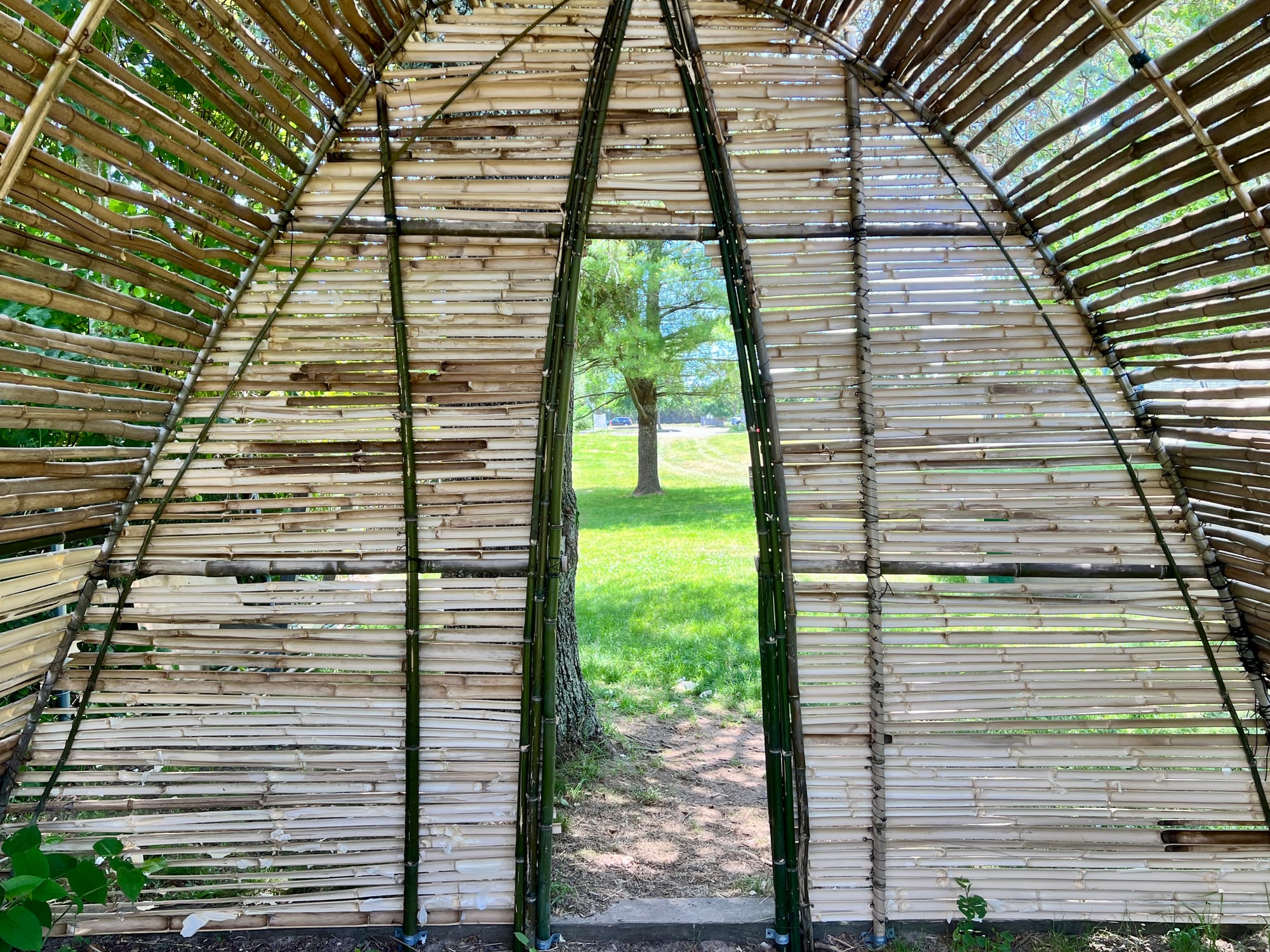
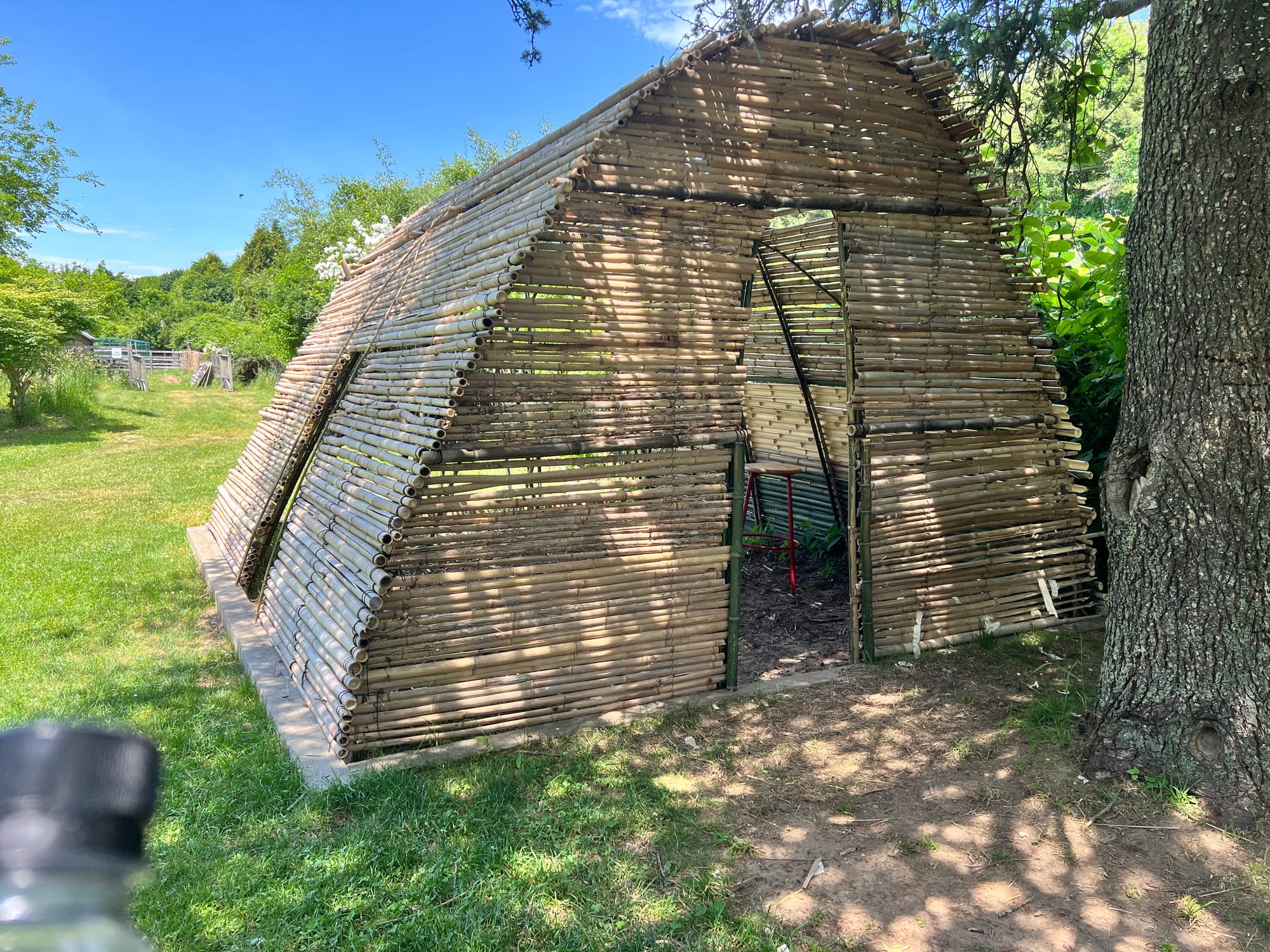
unfinished
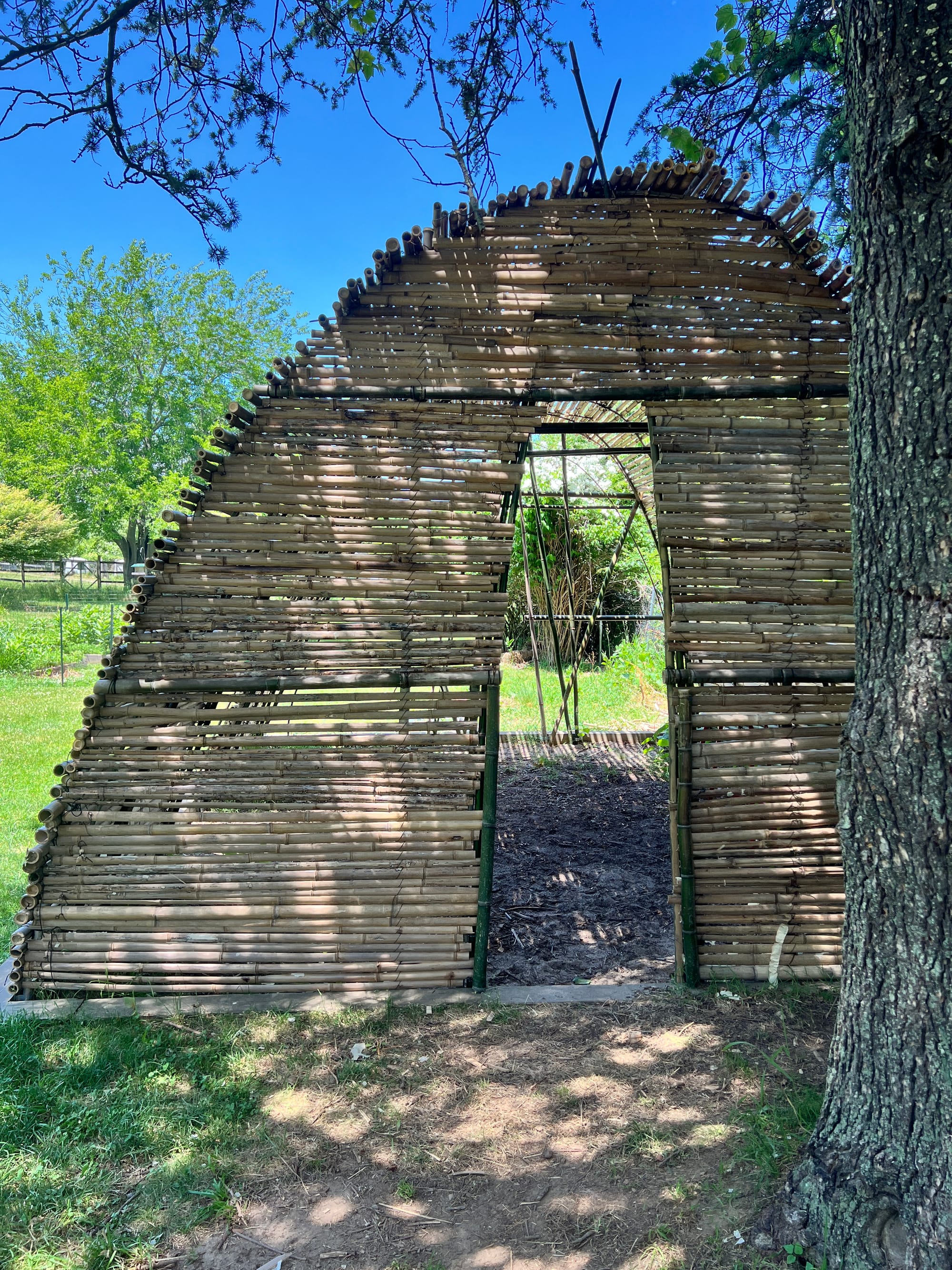
School ended the way school always ends, on a calendar square. Ceremonies marked the close. The longhouse stood where we left it, lashings drying, one wall still open.
What I noticed, in those last weeks, was what it had already become for people who engaged it. Kids would duck inside and tell each other stories. Adults paused in the slatted shade, light coming through the bamboo at angles, stripes of sun on the ground. Nobody asked what it was for in those moments. They stood there for a minute and moved on, quieter.
My hope is that the kids return to it in the fall to find it changed, dried further, maybe shifted, needing repair. I hope we pick up where we left off or take it somewhere new. Building together is its own kind of learning, with its own timeline, answerable to something other than the school year.
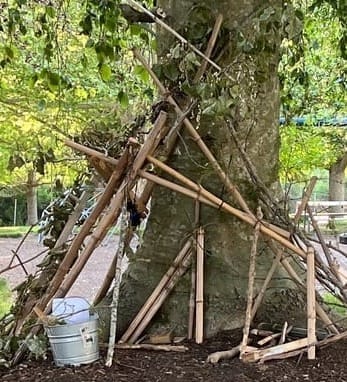
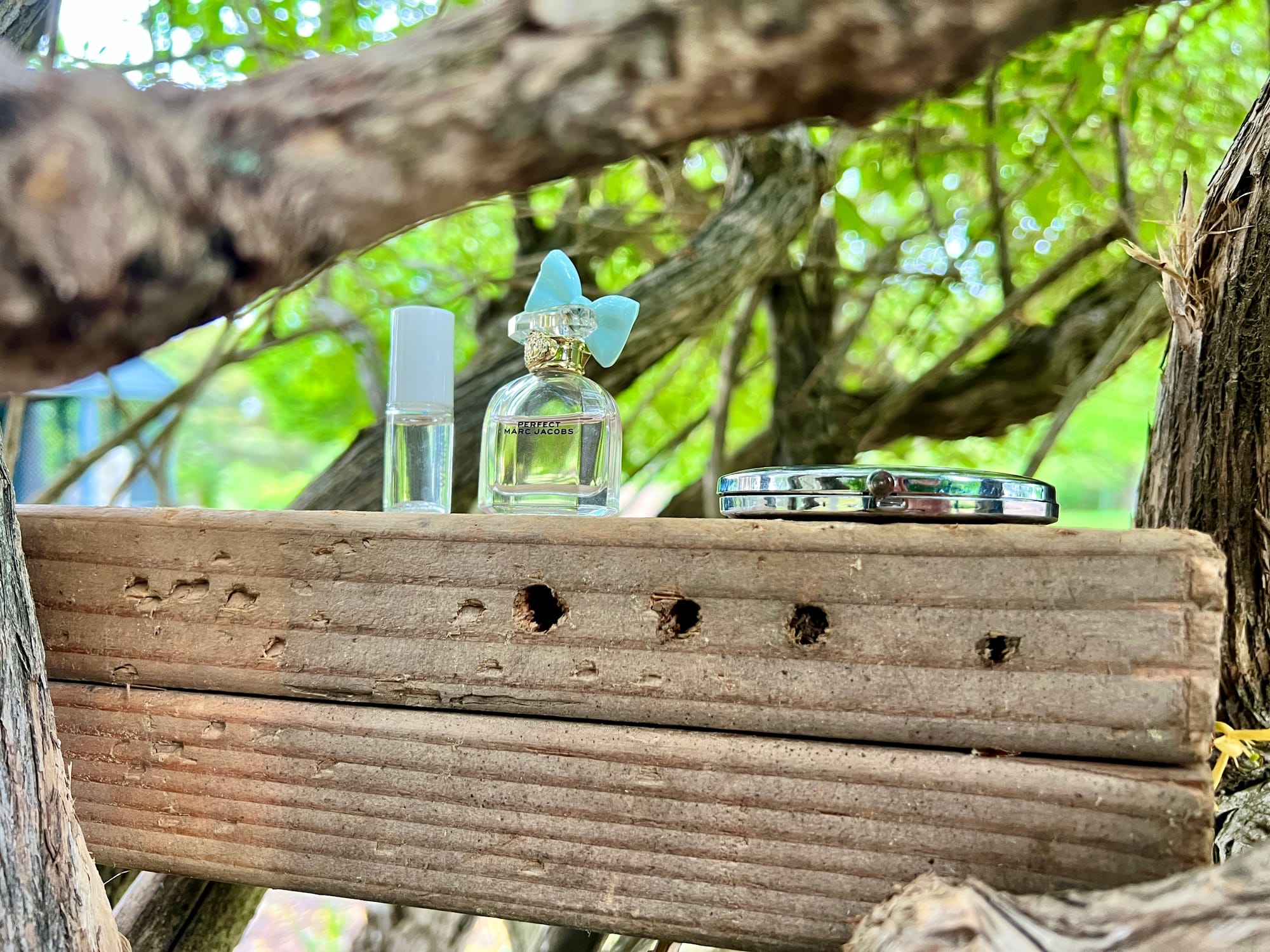
Toward the end of the semester, I built a sawhorse from some crooked 4x4s I'd pulled from a dumpster on a job site. As I cut, the bamboo offcuts fell to the ground, two feet, three feet, some longer, and the kids building their own stick houses nearby grabbed them. Word spread. Kids hauled the unused canes, some ten to twenty-five feet long, all over the grounds. New stick houses flushed up like mushrooms. Make-believe stores. Theaters. Hotels. Perfume shops.
Spring came with a scarcity of sticks. Now there was abundance.